ISBN-13 explained
An ISBN helps the book trade identify a specific book product. It is not copyright, and it is not proof of ownership. It’s an identifier used by systems. Combine that with visible authenticity on the cover and it becomes much harder for resellers to misrepresent your book using your cover image.
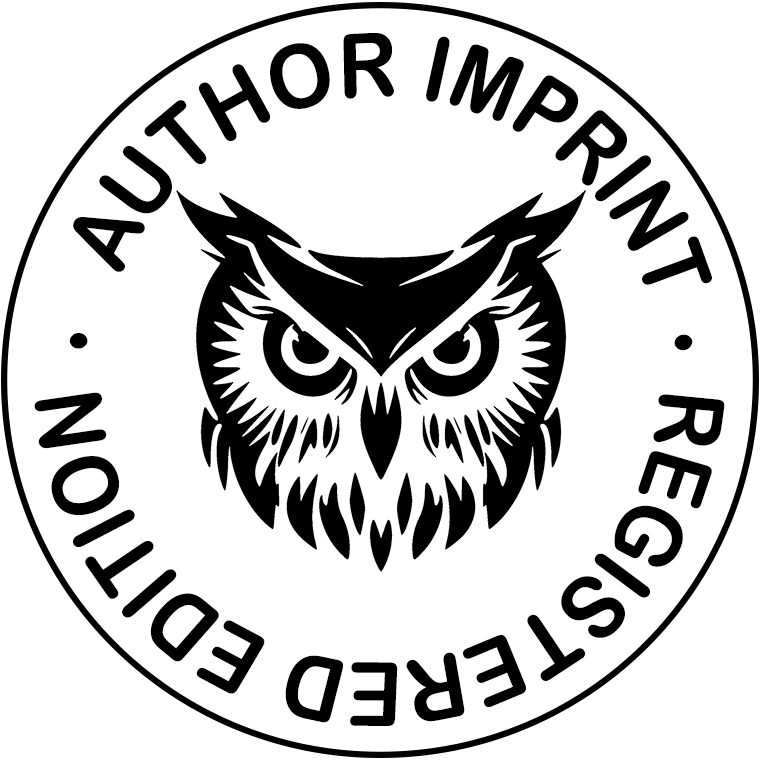
Why the Author Imprint Seal appears on the front cover
ISBNs support cataloguing and distribution systems. The Author Imprint Seal is designed for visual reference, helping readers and buyers recognise a registered record and locate the associated public Registry-ID page.
What the Seal is designed to support
- Visible reference: adds a small, consistent imprint mark linked to a public Registry-ID record.
- Record lookup: allows interested parties to view the associated public page for context.
- Format clarity: helps reinforce which format or record the cover was registered against.
- Brand consistency: supports a uniform presentation across an author’s catalogue.
What the Seal does not do
- It does not replace official ISBN agencies or ISBN assignment.
- It does not function as proof of copyright ownership.
- It does not prevent copying or unauthorised reuse.
- It does not alter the publisher-of-record unless the registrant controls the ISBN block.
What the Author Imprint Seal supports, in practice
Publishing often involves uncertainty around attribution, listings, and visibility. The Author Imprint Seal and Registry-ID record are designed to provide structure, consistency, and a clearer reference point when questions arise.
Clarity
- Single reference point: a public record that shows what was registered and how it was described.
- Reduced ambiguity: helps confirm which ISBN and format were associated with the record.
- Consistent information: supports alignment between cover, listing, and public details.
Consistency
- Repeatable presentation: the same imprint mark appears across registered titles.
- Format distinction: helps reinforce differences between paperback, hardback, or other editions.
- Catalog coherence: supports a more uniform look and structure across an author’s catalogue.
Confidence
- Transparent reference: allows others to independently view the Registry-ID record.
- Reduced explanation burden: less need to verbally clarify what belongs to which record.
- Professional signalling: presents the book as deliberately documented rather than informal.
Preparedness
- Documented context: the record exists before questions arise, not after.
- Clear next step: provides a stable link that can be referenced if clarification is needed.
- Lower friction: supports calmer, more measured responses to listing or attribution queries.
How ISBN visibility is used by third parties to locate book listings
ISBNs are designed to make books discoverable within publishing and retail systems. That same visibility can be used by third parties and automated tools to locate listings, reference publicly available metadata, and reproduce product pages in other contexts.
Common patterns observed in the market
- ISBN-based indexing: automated systems query ISBNs to identify titles and associated listing data.
- Cover image reuse: publicly visible cover images are sometimes reused in secondary listings.
- Metadata replication: titles, descriptions, and imagery may be reproduced with variations.
- Format mismatches: covers or descriptions may be paired with incorrect formats or editions.
How this can affect the rights holder
- Brand inconsistency: the same cover may appear in contexts outside the author’s control.
- Buyer uncertainty: differences in pricing, format, or fulfilment can cause confusion.
- Reduced clarity: it may be unclear which listing reflects the intended record.
- Additional effort: resolving questions often requires explanation or reference material.
ISBN FAQ — straight answers
No fluff. Just what the ISBN is, what it contains, what it doesn’t, and what to do in the real world.
Q What is an ISBN, in plain English?
An ISBN (International Standard Book Number) is an identifier used by the book trade to recognise a specific book product. Think of it like a SKU. It helps retailers, libraries and distributors avoid mixing up similar titles.
ISBNs identify a specific edition and format (paperback vs hardcover). They are not a “title ID”.
Q What is in an ISBN? What information does it contain?
An ISBN contains number segments that indicate a book prefix, a region/language group, a publisher/imprint range, a publication/item number, and a check digit used to catch errors.
An ISBN does not contain your title, author name, price, copyright, or sales rank. That information exists in databases that use the ISBN.
Q What are the 5 parts of an ISBN-13?
ISBN-13 is often shown with hyphens to reveal its parts:
- Prefix (usually
978or979) - Registration group (country/region or language area)
- Registrant (publisher/imprint identifier)
- Publication (specific title/edition item number)
- Check digit (math digit that catches typos)
Segment lengths vary by country and publisher range, which is why hyphen positions differ.
Q ISBN-13 vs ISBN-10: what’s the difference?
ISBN-10 is the older format. ISBN-13 is the modern standard and matches retail barcode systems. Many books display both, but ISBN-13 is what most current systems rely on.
ISBN-10 check digits can be X. ISBN-13 check digits are always 0–9.
Q Can two books have the same ISBN number?
Properly assigned, no. One ISBN should map to one specific book product (edition + format). If two different books appear to share an ISBN, you’re looking at a data error, a misassigned number, or a dodgy listing.
Reprints of the same edition often keep the same ISBN. A substantially revised edition should get a new ISBN.
Q Do all books have an ISBN? Is it illegal to sell without one?
Not all books have an ISBN. Some small print runs, private publications, zines, and niche products are sold without one. In most cases it is not illegal to sell a book without an ISBN.
Q What does it mean if a book does not have an ISBN?
Usually one of these:
- It was never assigned an ISBN (private or small-run publishing).
- It uses a platform identifier instead (internal product codes).
- It’s old (pre-standard adoption) or from a niche publisher.
- The ISBN exists but isn’t printed (rare, but possible).
Q What to do if a book has no ISBN?
Decide what you need it for.
- Retail/libraries/distribution: you almost certainly want an ISBN.
- Direct sales only: you may not need one.
If you want marketplace clarity: ISBN + consistent metadata + a front-cover Seal is a strong combination.
Q How long do ISBN numbers last? Do ISBNs expire?
ISBNs generally do not “expire”. Once assigned to a specific product, they should remain associated with it, even if the book is out of print.
“Expired ISBN” claims usually confuse ISBNs with a service subscription, a database listing, or a platform rule.
Q Can I use an old ISBN?
Only if it was legitimately assigned to the same product you’re selling (same title, same edition, same format). You cannot recycle an ISBN from a different book.
Q How do you check if an ISBN is valid or not?
There are two different “valid” checks:
- Math-valid: the check digit matches (catches typos).
- Market-valid: the ISBN is actually assigned to that title/format in databases.
A math-valid ISBN can still be wrong for the book if someone copied an ISBN from another listing.
Q Why do books have “10 9 8 7 6 5 4 3 2 1”?
That’s a printer’s key (number line). It indicates the printing. The lowest number present usually indicates the printing number.
10 9 8 7 6 5 4 3 2 1often means first printing.- If the
1is missing and the lowest is2, it’s typically second printing.
Publishers format number lines differently, but the “lowest number rule” is the usual guide.
Q How much does 1 ISBN cost? Can you buy one? Can you get one free?
Yes, you can buy ISBNs from the official ISBN agency for your country. Pricing varies and changes over time.
- Australia: single ISBN is commonly listed around AUD $44, with blocks reducing per-ISBN cost.
- United States: single ISBN is commonly listed around USD $125, with bulk packs cheaper per unit.
Q Does every book format need its own ISBN?
In professional publishing, yes. Each format (paperback, hardcover, audiobook, etc.) typically needs its own ISBN. This prevents supply-chain confusion and keeps ordering accurate.
This is where the front-cover Seal helps: it keeps attribution tied to a specific record and format, not a vague “trust me” claim.